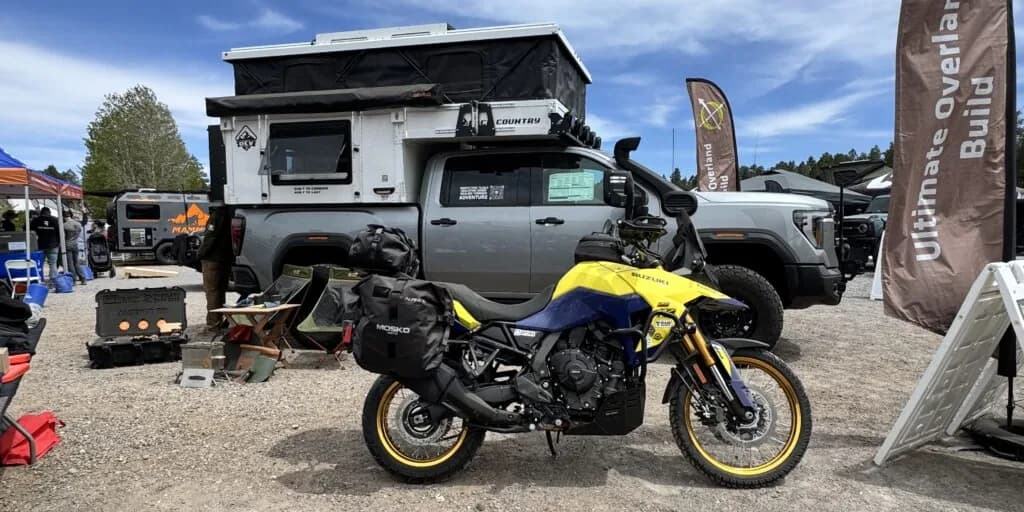
When you're about to spend real money on a truck camper, the spec sheet only gets you so far. What you want to know is whether anyone credible looked at it closely and trusted it with something that mattered. For 2025, Overland Expo did exactly that with the Back Country.
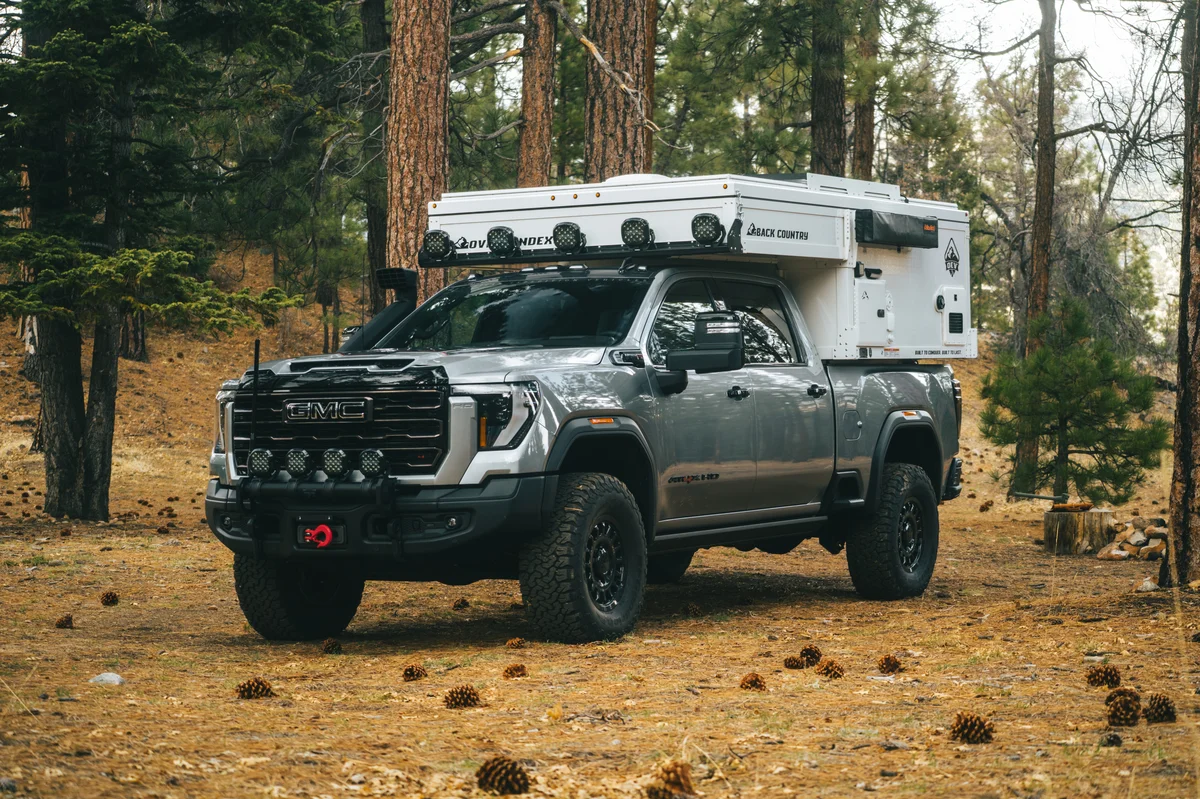
In 2025, Overland Expo chose the OEV Back Country 6.85 pop-up slide-in camper for the Overland Expo Foundation Ultimate Overland Vehicle Build. Overland Explorer Vehicles (OEV) donated the camper. It rode on a diesel 2025 GMC Sierra 2500 HD AT4X AEV Edition, was installed by Tiny Rig Co., toured all four 2025 Overland Expo events, and was auctioned on Bring a Trailer with all proceeds going to the Overland Expo Foundation. At Overland Expo Mountain West, Arnold from OEV walked the rig top to bottom. This post covers what he showed.
What the 2025 Ultimate Overland Build Was
For 2025, the Overland Expo Foundation's Ultimate Overland Vehicle Build toured the Expo season and was then auctioned to raise money. The Foundation funds conservation and education work, and Arnold points out it reaches well past the United States, including trail cleanup.
For 2025 the pieces were:
- Truck: 2025 GMC Sierra 2500 HD AT4X AEV Edition, diesel
- Build partner: American Expedition Vehicles (AEV), who added suspension and more to the truck
- Camper: OEV Back Country 6.85 pop-up slide-in
- Camper installer: Tiny Rig Co.
- Tour: revealed at Overland Expo West in May 2025, then shown at all four 2025 Overland Expo events
- Finish line: auctioned on Bring a Trailer, all proceeds to the Overland Expo Foundation
Why OEV said yes comes down to one line from Arnold: the goal was to give back to the community that helped build the company.
The rig has sold and belongs to its new owner now. The camper on it is the same Back Country you can order today.
Watch the Walkaround
Arnold covers the whole camper, outside first and then inside. If you'd rather read, everything below follows the same order.
A Fully Loaded Back Country
Most show campers get a few extras. This one got the options list. In Arnold's words, "We threw every available option that we have," plus one that hadn't been released yet: a prototype rear storage box.
That makes this rig a useful reference. If you've been wondering what a loaded Back Country looks like in person, this is it.
Starting up top, the camper carries the OEV front off-road light bar. OEV supplies the aluminum bar and you choose the lights. There's also a mounting spot for recovery boards like MAXTRAX on either side, and Arnold says that idea came straight from a customer. People who use these campers hard have OEV's ear when they find a better way to do something.
The low pop-up profile matters here too. With the roof down, the camper sits at 62 inches closed. That keeps it under low branches and rock outcrops on the trail, and Arnold notes the smaller frontal area cuts wind on the highway, which helps fuel economy.
Outside the Camper
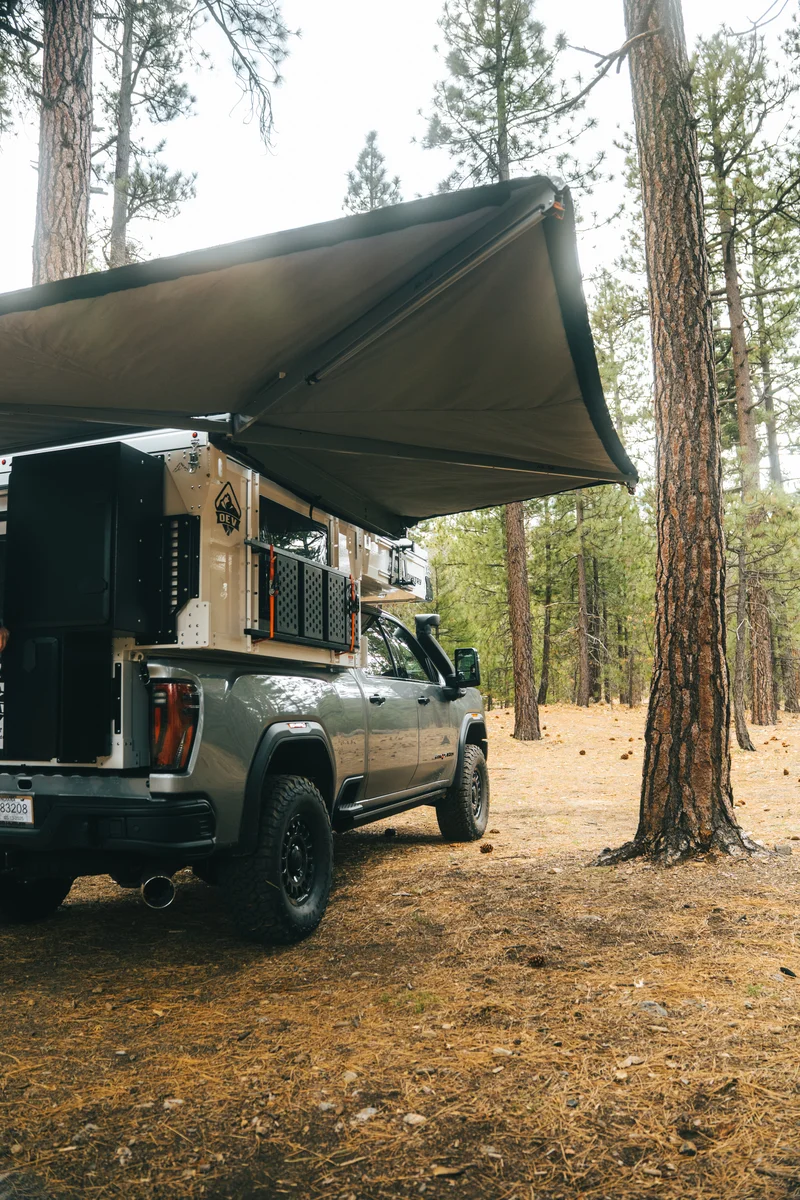
The Alu-Cab 270 Awning
The build runs an Alu-Cab 270 awning, which wraps around the corner of the camper. A 270 puts most of its load on one point, the rear corner where it pivots. OEV reinforced the corner caps at the top of the wall there, so the aluminum exoskeleton can handle that load if the awning is left open in a wind. The front mount ties into the top-of-wall extrusion, which is already tied into the rest of the structure.
The awning has a drop leg if you need it. Arnold's advice still holds: "when the wind comes up, put your awnings in, folks."
Folding Stairs
The OEV folding stairs are aluminum, powder coated, and very light. The tread is close to 12 inches deep, so your whole foot lands on it. The coating is an anti-skid finish infused with rubber crumb and crushed glass, which grips even when your feet are wet.
On a slide-in, the stairs store on a mount outside the passenger side window. That mount does double duty on the trail, giving the window some protection from branches. If your camper sits on an Aluma Tray flatbed, the stairs slide into the front bulkhead instead. At camp, a bracket at the bottom of the doorway holds them in place.
The Prototype Rear Storage Box
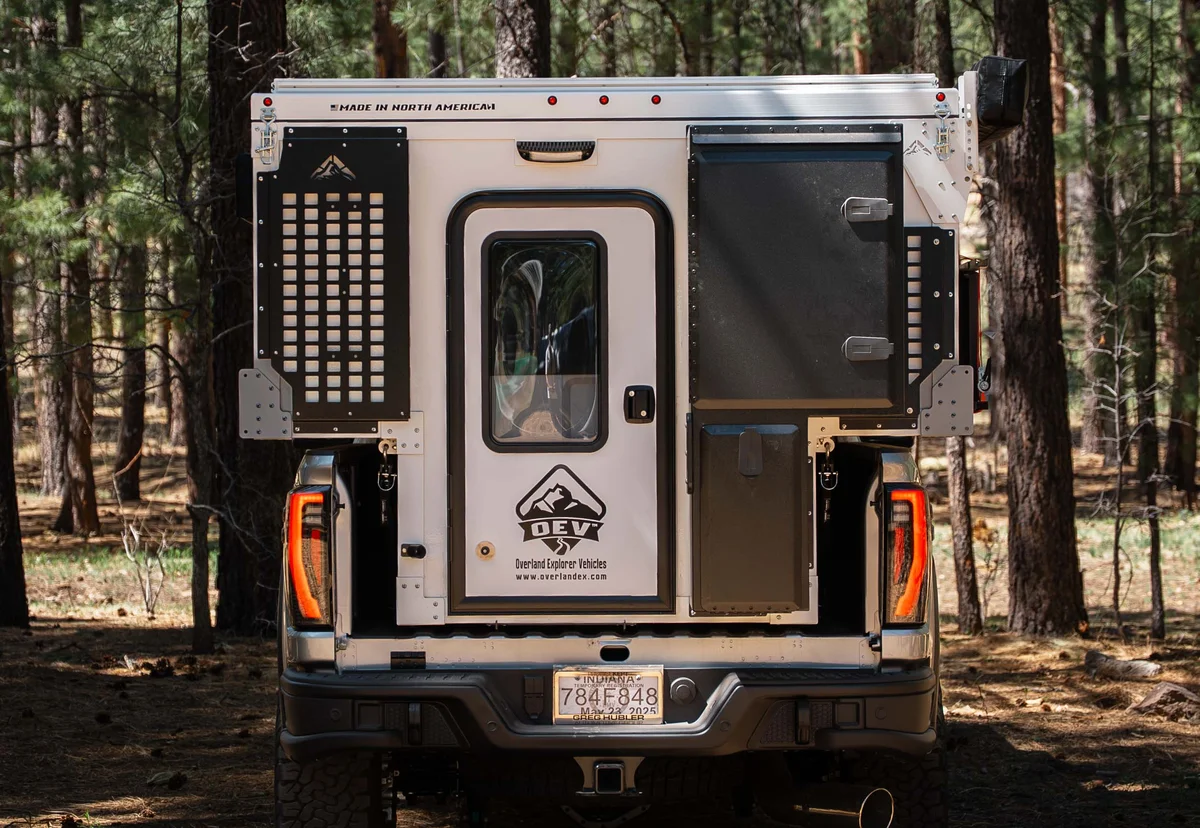
This was the new piece on the build. The box mounts on the rear passenger side using the same mounting points as the MOLLE panel, so an existing Back Country (or a Camp X, as it used to be called) can swap the panel for the box.
- Two doors, both lockable
- An adjustable shelf that can hold a grill, with holes through it for fishing rods and rod mounts at the bottom
- A sliding trap door that splits the box into two separate compartments
- Venting, so wet waders and gear can hang and dry
The production version is a little taller than this prototype, so keep that in mind when you plan your awning mounting.
Window, Lights, and Utilities
The passenger side window is big: a dual pane acrylic window, 600 by 900 mm, with a pull-up blind and a pull-down screen. It sits right beside the dinette, so it opens up cross-breeze and doubles as a pass-through when you're cooking outside. LED exterior lights cover the passenger side, driver side, and rear.
The entry door is pet-safe, so a dog bumping into it won't pop out the screen. Arnold also points out its brass bushings. Grab the end of the door, lift, and you can feel the whole camper move with it.
Around on the driver side you'll find the propane, an outside light, shore power, the outside shower port, a lockable fresh water fill, and the gray water drain. Brackets and adapters for an exterior shower enclosure come standard, and you supply the enclosure. The build ran an Alu-Cab shower cube. There's also a port for running an extension to a second portable solar panel, handy when you're parked in the shade.
How the Camper Stays Put
People ask this at every show. The Back Country doesn't rely on the tie-down points in the truck bed, because those aren't rated for the load.
Up front, a powder-coated steel bar runs across the front of the camper and mounts directly to the truck frame. Tie-downs at the back finish the job, and where they sit on the bed depends on the make of truck. The connection uses Derringer spring-loaded over-center latches, secured with a pin or a lock.
The camper rides on rubber feet. Off-road, the spring-loaded latches let it move a little and then pull it back to center, instead of fighting every twist of the chassis.
Heat, Water, and Power
OEV runs Truma across the lineup: the Truma Vario cabin heater and Truma Aquago on-demand hot water, both on propane. Arnold says the only Truma problems he's ever really seen came from someone forgetting to winterize the Aquago.
That's worth being clear about. The Back Country is a four-season camper. The water system is the three-season part and needs to be winterized before freezing temperatures.
OEV once ran this camper at -15°F (-26°C) with the roof up and the windows closed, holding the thermostat around 72°F. Over four hours, it used about half a pound of propane.
The fresh tank holds 20 gallons. That sounds small by older standards, but water systems have changed. Every Back Country ships with a Geyser adapter kit, which stretches a shower a long way. Portable filter-and-UV systems also let you refill from a stream when you're far from a tap.
On power, the Back Country comes standard with a 220W hail-proof solar panel, a Victron 100/50 MPPT controller, and a Victron Orion XS DC/DC charger. A second panel is an option. The Ultimate Build ran a 270Ah lithium battery and the optional 2000W Xantrex inverter.
Inside the Back Country
The Back Country is a rear-entry camper with a small floor plan, but it's laid out so two people can work at once. One can cook in the galley while the other sits at the dinette, and you're not in each other's way.
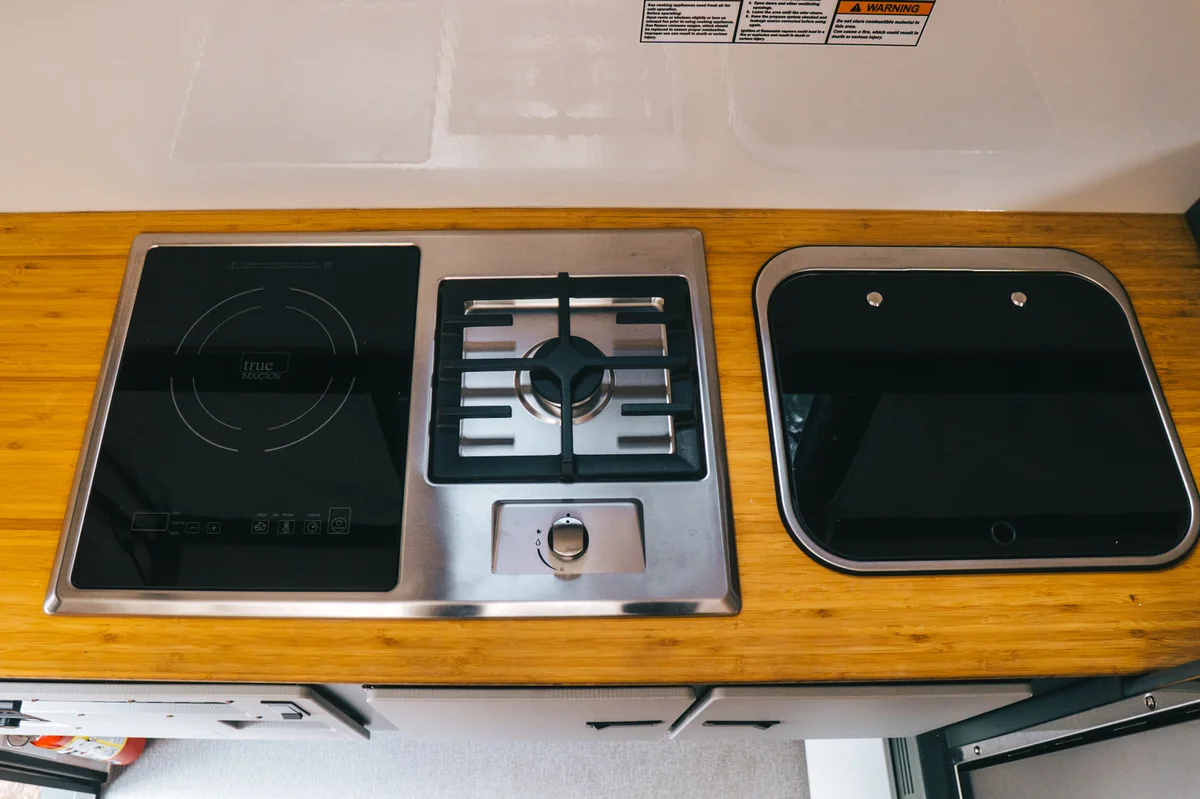
Standard equipment includes a two-burner propane cooktop, a stainless sink with a flush-mount glass top, one multi-speed roof fan (a second is optional), and bamboo countertops and table. Look closely at the top of the walls and you'll see a strip of fire-rated EVA foam. The aluminum extrusion there runs to the outside, and the foam breaks that thermal path. It's also soft, which you'll appreciate the first time you bump your head in the bed area.
The Ultimate Build added the options you'd expect on a maxed-out camper:
- Induction and propane cooktop. One induction burner and one propane burner, replacing the standard two-burner propane. It needs the 2000W inverter, and the induction unit pops out so you can cook outside.
- Isotherm 65L compressor fridge
- Under-seat storage. Every seat cushion has storage under it. Without the fridge, that storage runs all the way to the galley.
Two sleeping options are worth knowing about too. Taller people who find the east-west bed short can add the king bed extension. A gurney bunk pins in north-south over the dinette and doubles as a place to stash duffel bags at night, though it can't be combined with under-seat storage.
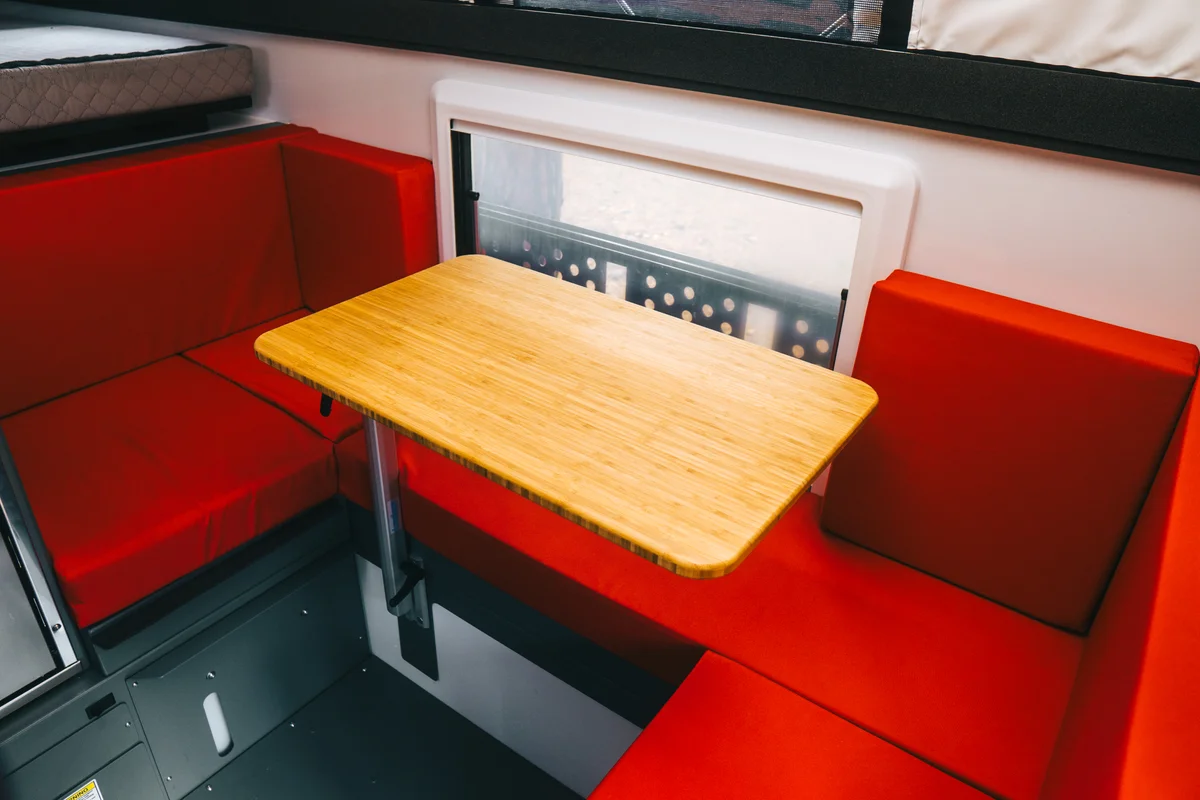
The dinette converts to a 38 by 77 inch bed, about 6'5". Arnold's favorite detail is that you can sleep there without popping the roof. At a rest stop or a quick overnight in a parking lot, you just climb in.
The soft walls are a fire-rated coated fabric that wipes clean, ketchup and red wine included. There are four layers. One is insulation, and an inner membrane takes most of the stitching, so fewer needle holes go through the outer fabric.
How the Shell Is Built
This is the part Arnold gets most excited about. The roof, walls, and floor are all composite, but each one is built differently because each has a different job:
- Roof: about 1.5 inches thick with EPS foam, to keep weight down while staying structural
- Walls: about 1-5/8 inches thick, gelcoat fiberglass on both faces with honeycomb polypropylene and PET foam inside
- Floor: about 1-5/8 inches thick, gelcoat on both faces with a honeycomb polypropylene core for strength
The panels are laid up wet and held under vacuum until the resin cures. Everything inside is bonded in place, and fasteners only show up where metal meets metal. That's on purpose. The camper is built to flex with the truck, and the furniture is aluminum, so there's no wood to rot or delaminate. The shell is rated R8, and the soft walls are rated R4.
OEV has used urethane foam in the past and moved to PET foam after testing. Arnold says that's how every change gets made: through destructive testing, and only if it improves the structure. In one test OEV posted on YouTube, a single bonded panel joint lifts a 250 lb KTM 300 dirt bike. His summary: "we learn by doing, but we learn even more by testing and we test everything to failure."
He finished with the line that sums up how OEV builds: "I wouldn't build anything I wouldn't want to own myself."
What Independent Reviewers Said
Plenty of outlets covered the 2025 build. These are some of the things they wrote about the camper.
"After careful consideration, they chose the OEV Back Country, a robust pop-up truck camper engineered for remote travel in challenging environments."
Graeme Bell, Expedition Portal, 6 May 2025
Expedition Portal publishes a No Compromise Clause stating it accepts no advertorial and does not let advertising influence its reviews.
"It features a removable four-season cabin, a three-season water system, and R8-rated insulated composite walls that support comfort in various temperatures."
Graeme Bell, Expedition Portal, 6 May 2025
"The OEV Back Country slide-in truck camper, which offers four-season capability and R8 insulated composite walls, has its own off-grid system"
Nathan Adlen, Autoblog, 13 June 2025
"The OEV Back Country uses R8-rated insulated composite panels and dual-pane thermal windows."
Gordon White, Truck Camper Magazine, 23 July 2025
OVR Magazine also covered the build, and the Overland Expo Foundation has published its own videos of the rig.
Which Truck It Fits
The Ultimate Build put the Back Country on a GMC Sierra 2500 HD, a three-quarter-ton. That's the middle of its range. The Back Country fits factory half-ton, three-quarter-ton, and one-ton trucks with 6'0" to 6'8" beds, and it weighs 1,275 lbs dry, excluding jacks and batteries.
On a half-ton, check the payload on your driver's door sticker before you order, and plan for water, batteries, and gear on top of the dry weight. Arnold's advice is to talk to OEV or one of the OEV dealers early. They can help you pick a truck, or tell you what mods your current truck might need. For the bigger picture on slide-ins, the slide-in pop-up truck camper guide covers the trade-offs.
Back Country or Hudson Bay?
If the Ultimate Build has you looking at OEV, these two are the usual cross-shop. The Back Country keeps your factory bed and fits half-ton through one-ton trucks. The Hudson Bay 6.75' pop-up needs a flatbed and a three-quarter-ton or one-ton truck, and in return it adds a wet or dry bath and a longer interior. Same composite build, different trucks and different trips. The full side-by-side is in our Back Country slide-in truck camper overview.
Price and Build
The Back Country 6.85 starts at $51,445. That covers the standard build: the composite shell, Truma heat and hot water, 220W solar with Victron charging, the 20-gallon water system, the queen bed, and the C-shaped dinette.
The Ultimate Build shows how far you can take it from there. The induction cooktop, 2000W inverter, fridge, under-seat storage, light bar, storage boxes, folding stairs, and tie-down kits are all on the options list, and you can price each one in the configurator.
Configure Your Back Country
Start with the standard build, add the options from the Ultimate Build that fit how you travel, and watch the price update as you go.
Built to Conquer. Built to Last.
Overland Expo put the Back Country on its 2025 Ultimate Build, and it spent a full season on the show circuit for everyone to climb through. It's the same camper you can order today, from the standard build all the way to fully loaded. Build yours in the configurator, or talk to the OEV team about what fits your truck.