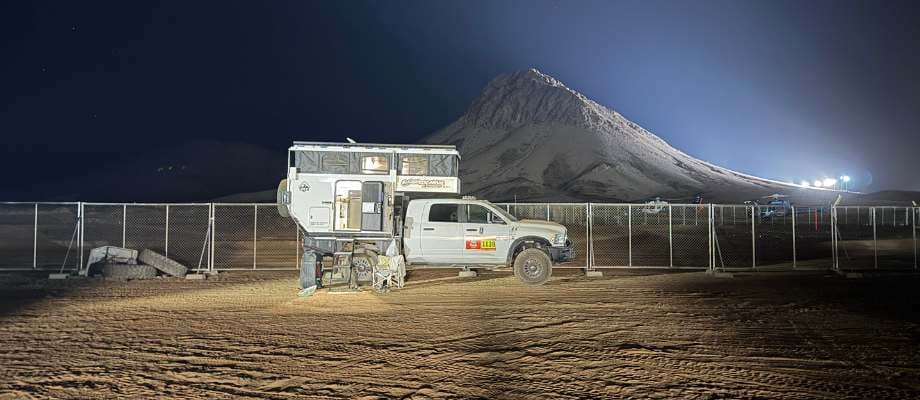
The Dakar Rally spans 7,000 kilometers across Saudi Arabia's most demanding terrain over twelve days. While race vehicles get all the attention, support teams face their own critical challenge: finding reliable shelter, workspace, and rest between competition stages. Equipment failure in camp can end a team's participation just as effectively as a mechanical failure on course.
This year, one customer equipped their chase vehicle with an OEV Hudson Bay 6.75 mounted on an Aluma Tray flatbed. Where competing RV-style campers deteriorated under extreme conditions, this setup remained completely functional throughout.
The Challenge: Racing Dakar From the Support Side
The competitor had previously raced Dakar five times, most recently in 2019, and returned for the Dakar Classic vintage competition. Support operations require managing spare components, mechanical tools, and crew recovery space. While organizers provide basic facilities, sleeping arrangements fall entirely to teams.
The customer selected the Hudson Bay 6.75 specifically for serious overland performance under the planet's most demanding road conditions.
The Proving Ground
Dakar roads consist of hundreds of kilometers of corrugated gravel that create relentless vibration. Temperature fluctuations ranging from 4°C to 25°C test seals and electrical systems. Traditional RV construction (wood frames and screw-assembled cabinetry) fails catastrophically under these conditions. The customer watched competing campers suffer broken cabinets, seal failures, and structural deterioration while attempting to support race operations.
Built Different: The OEV Performance
The camper performed exceptionally throughout. In the customer's own words:
"It has been incredible to have the OEV Hudson Bay as our base camp for the rally. It is so comfortable. I sleep on the upper bed and my co-driver sleeps on the lower bed."
Living space. The camper provided sufficient room for relaxation, roadbook review, reading, personal hygiene, and equipment organization, essential given the demands of a multi-week rally.
Electrical systems. The dual charging system proved invaluable. As the Ram engine powered daily stages, the DC-to-DC charger efficiently replenished camper batteries. Solar panels on the roof captured Arabian sun during stationary periods, maintaining peak capacity without requiring generator operation.
Structural integrity. The customer confirmed: "The roads here in Saudi range from smooth blacktop to hundreds of kilometers of corrugated gravel roads. The OEV has had zero issues. Build quality is excellent and it gives us confidence to cruise at the speeds we need to in order to make it to the next base camp to meet the race car."
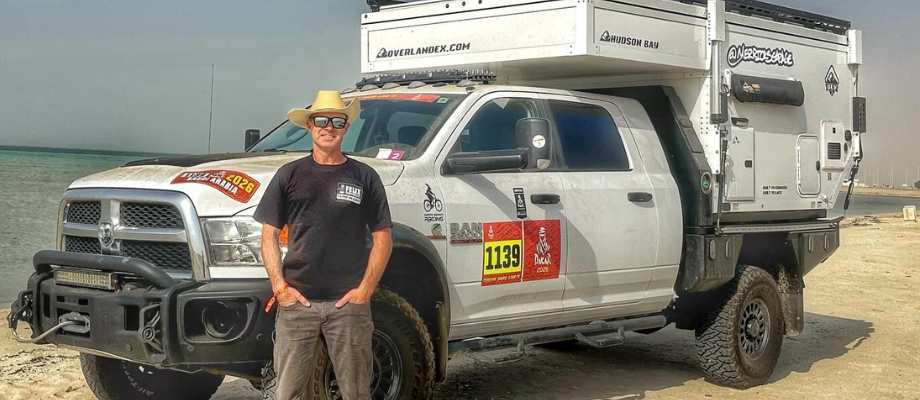
The OEV Difference: Engineering That Shows Up When It Matters
Aluminum exoskeleton. Unlike moisture-absorbing wood frames, the aluminum structure maintains rigidity under constant vibration and impact, providing load-bearing structural integrity rather than decorative framing.
Proprietary composite walls. Specially engineered panels deliver superior insulation and strength without traditional RV construction vulnerabilities. They resist delamination under stress and temperature extremes.
Integrated aluminum furniture. Cabinet and storage systems contribute to the overall structural rigidity rather than functioning as separate additions. This unified framework prevents cabinet failures, loose fasteners, and particle board deterioration.
Fully isolated mounting system. Three-stage vibration isolation (between chassis and tray, and between tray and camper) prevents destructive energy transfer and premature component failure.
Component quality. Every element prioritizes reliability over cost reduction.
The Verdict
The customer's conclusion says it all:
"I'm thrilled with the camper and highly recommend it to anyone who is looking at doing a multi-week adventure that requires quick setup and takedown and the ability to drive on any kind of road."
The Dakar performance demonstrates that properly engineered campers deliver reliability when standard help remains inaccessible. Whether you're traversing South America, remote North America, or comparable destinations, proven expedition equipment is the difference between making camp and making calls for help.