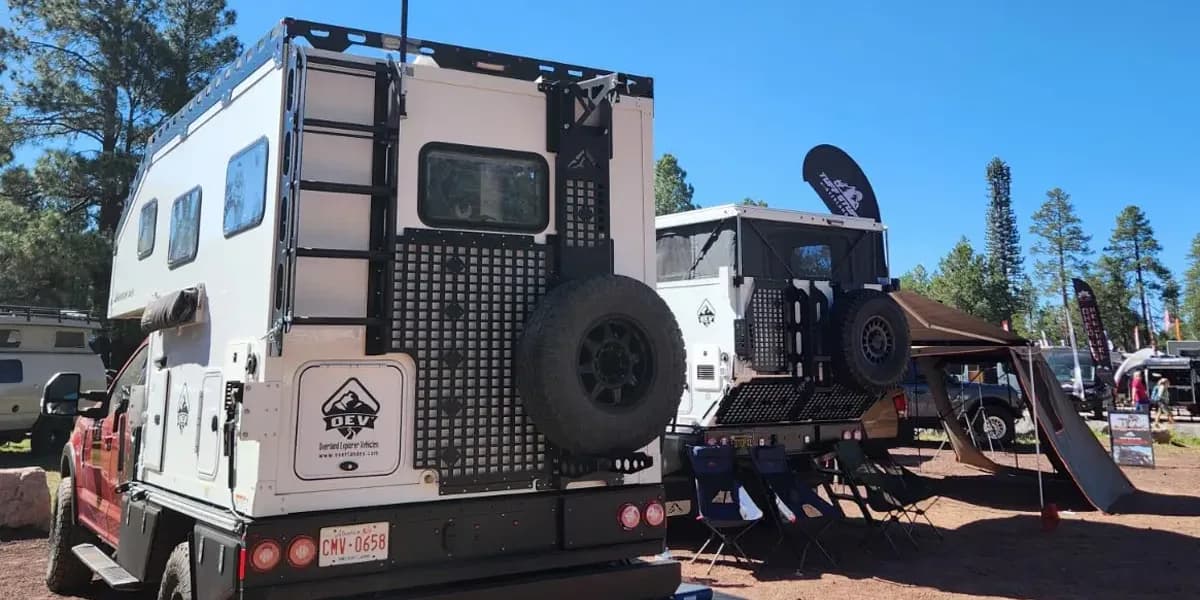
Every truck camper brochure says the camper is tough. What you actually want to know is how it was tested, and whether the company would show you. At Overland Expo Mountain West 2024, Ken sat down with Arnold from Overland Explorer Vehicles to talk about exactly that: where OEV came from, and the testing behind the phrase on every camper, Built to Conquer, Built to Last.
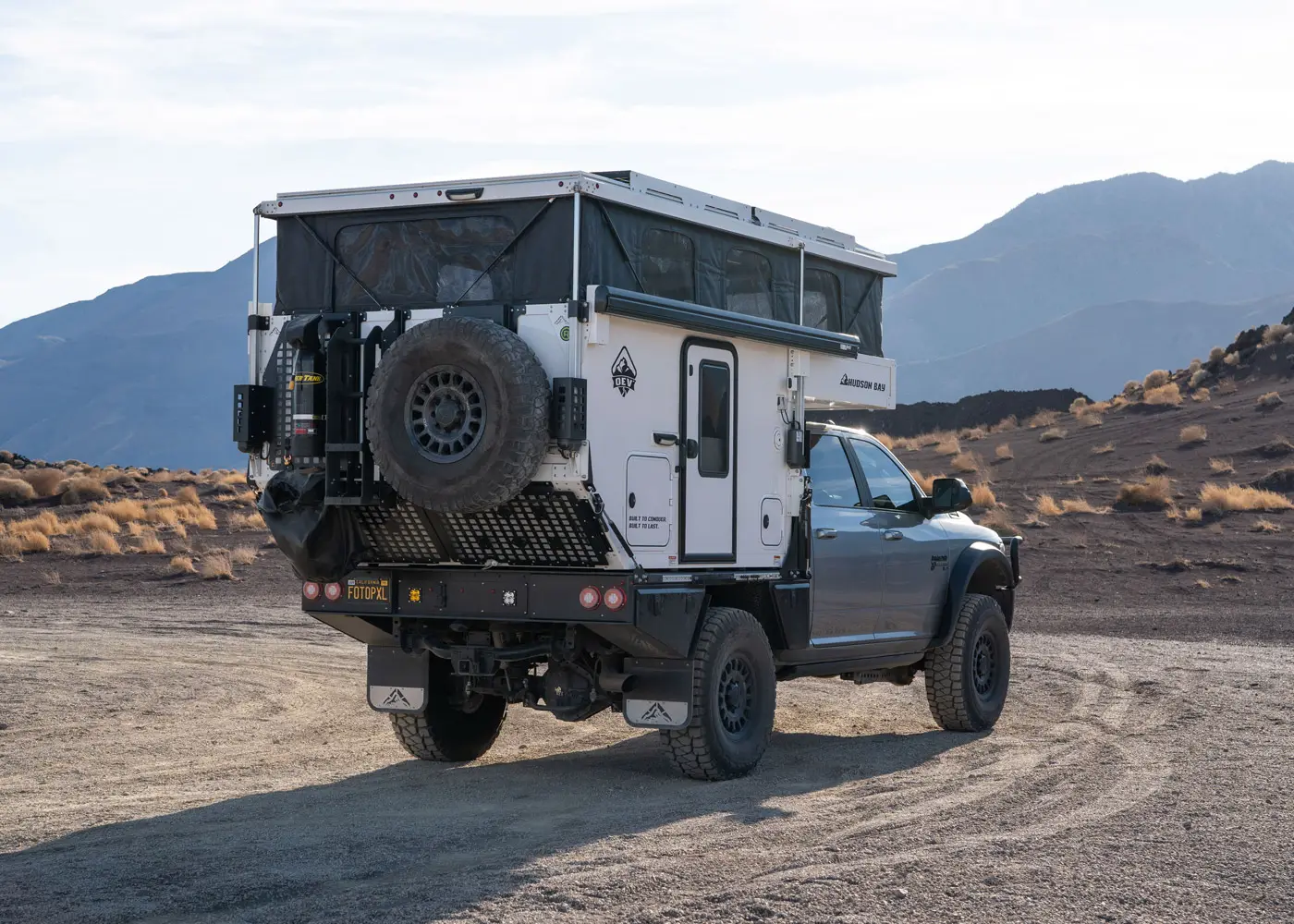
Overland Explorer Vehicles (OEV) builds composite truck campers under Lite Industries, a company that started out building equipment for the oil, gas, and mining industries. OEV campers use proprietary Gen 4 composite panels, bonded aluminum extrusions, and aluminum furniture, with no wood in the build. Today the lineup covers four truck camper families: Back Country, Hudson Bay, High Country, and Summit.
How OEV Started
Arnold calls it a pretty short story. Between him and his business partner Mark, they've owned just about every kind of rig except a van. They even did a stint as a Mercedes master outfitter, building out Sprinters.
Mark was the one who kept building. Years ago he built a service body for a slide-in Bigfoot camper. Then he built himself a motorhome by hand, with an aluminum frame and spray foam insulation. It took him about two years.
Back then, Lite Industries was an oilfield service company. It built equipment for the oil and gas and mining industries. When an opportunity came up to build a service body out of composite panels, the team designed the dies, made the extrusions, had panels made, and put it together. Arnold looked at the finished piece and saw it right away. It looked like an RV. Mark was all in, and the next step was the very first camper.
That first camper, built by hand, is still on the road. As of 2024, it belonged to a woman who had lived in it full time for around six years, last Arnold heard in Utah.
Then the Canadian oil and gas industry crashed, and it still hadn't recovered by the time of this interview. Campers went from a side project to the whole business. Arnold is honest about what that looked like: a completely underfunded startup, burning through every dollar the company had saved.
Eight Months of Adhesive Testing Before the First Camper
Before OEV built its first commercial camper, the team spent close to eight months testing adhesives alone. Plural component adhesives and just about everything else, pulled apart in tests run all the way to destruction.
"It's mind-blowing what adhesives can do," Arnold says. The auto and aircraft industries rely on them heavily. As he puts it, if people knew how much glue holds some airplanes together, it might make them nervous. After that testing, he isn't.
What's Inside a Gen 4 Panel
OEV's panels are proprietary. No other camper builder can buy them off the shelf. The first generation was a straightforward honeycomb panel with FRP skins on both sides. The current Gen 4 panel is a different build entirely:
- A complete wet layup, cured under vacuum on a vacuum table
- Gelcoat on both outside faces
- Honeycomb polypropylene layers on both sides
- A PET foam core made from recycled water bottles, manufactured in the USA
Arnold says it's the foam's specific density, along with a few other details, that lets it hold a bond.
Tested in Public
OEV has posted several of its tests on YouTube. Ken brought up one where a heavy-duty Ram sits on top of a box built from OEV panels. The box has no adhesive at all. It's dry-fit together like a jigsaw puzzle.
In another, a wall panel is cut and bonded into a T shape, then hung between the forks of a forklift. Hanging from it is a dirt bike full of fuel, around 250 lb. The only thing holding it up is about 12 square inches of foam bonded to the panel skin.
The corners get the same attention. OEV's 3 by 3 inch extrusions give 9 square inches of reliably bonded surface, and Arnold puts the force needed to break that bond at about 4,200 lb for every inch.
Not all composite panels are made equal. Plenty are imported and built very differently. If you can get a sample, clean the foam, then drag a fingertip across it using only the weight of your finger. If there's residue on your fingertip, the top few layers of foam cells are breaking down. That foam can't hold a bond, and when the joint fails the glue comes away feeling like peach fuzz.
Arnold says OEV's foam leaves no residue, even when you press down. When one of its bonds is broken on purpose, it tears out 3/4 to 1 inch of foam in a V pattern.
The over-cab bed test
Walk a show floor and look at where the over-cab bed meets the vertical wall. Some campers have a gusset there. Arnold reads that one of two ways: either the builder hasn't done the testing, or they have and they know it's a weak point.
Mark set up a bench test on that joint using Gen 3 panels and worst-case assembly: no sanding, no cleaning, just glue it together and let it cure. It also left out the corner cap extrusion that ties into the top of the wall on a finished camper. Then he pushed 1,000 lb of force down on the very end. Some deflection showed up at the fulcrum, and at 1,000 lb Arnold stopped caring, because nobody is going to put 1,000 lb on the end of a bed. The current Gen 4 foam is stronger, and he'd like to run it again.
Aluminum Furniture, Bonded In
The strength doesn't stop at the shell. The furniture is aluminum, and it's engineered piece by piece. The galley alone uses three different thicknesses of aluminum, because each part of it does a different job. Arnold describes it as geometry: every piece that goes in makes the whole assembly stronger.
It's all bonded. Where metal meets metal, OEV adds fasteners like rivets, and those joints are bonded with adhesive too. Arnold admits the rivets probably aren't even needed. "Mark tends to over-engineer everything," he says, and you'll appreciate that five years later, when you wash the camper and it looks like the day you picked it up.
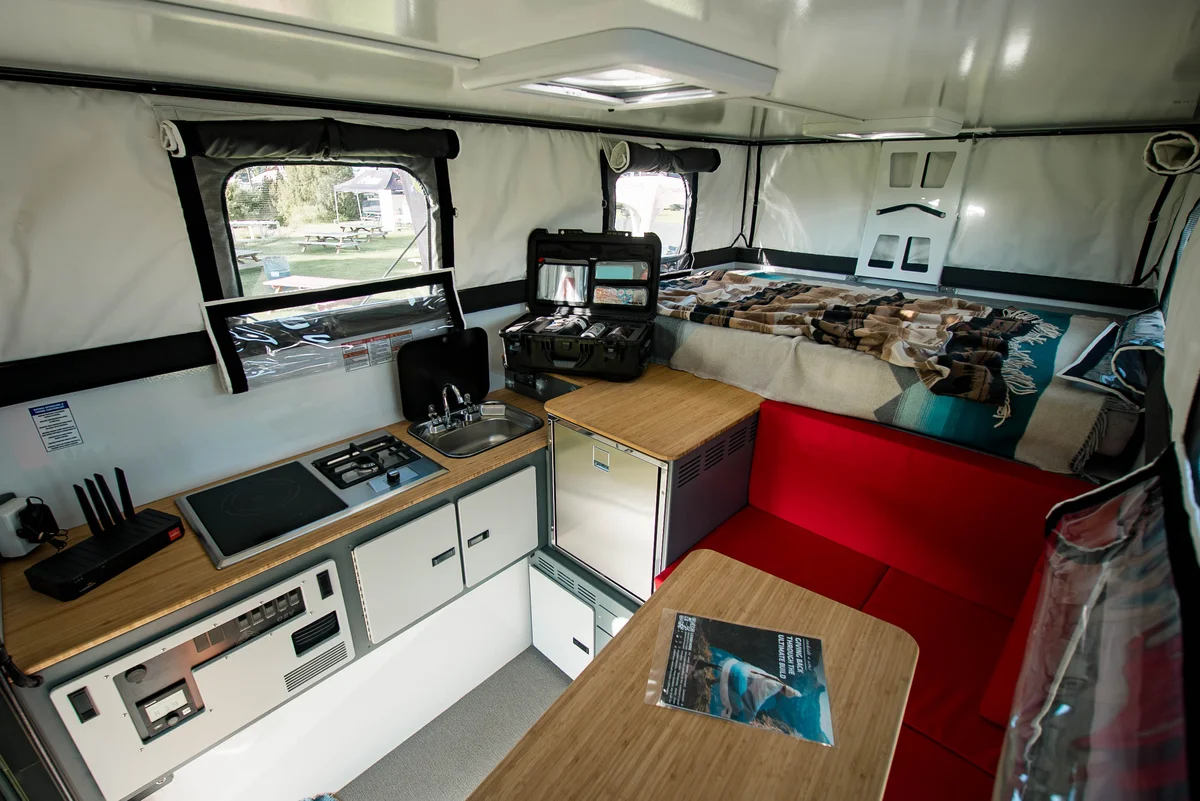
Ken backed that up with a 2021 unit of the camper now sold as the Back Country 6.85. After a wash, it looked just like the new ones on the show floor. Owners take these campers off road, beat them up, wash them, and do it again. Ken calls it beat, wash, repeat. Arnold calls it repeated reliability, and says that's the whole goal.
Soft Walls Built Like the Rest of It
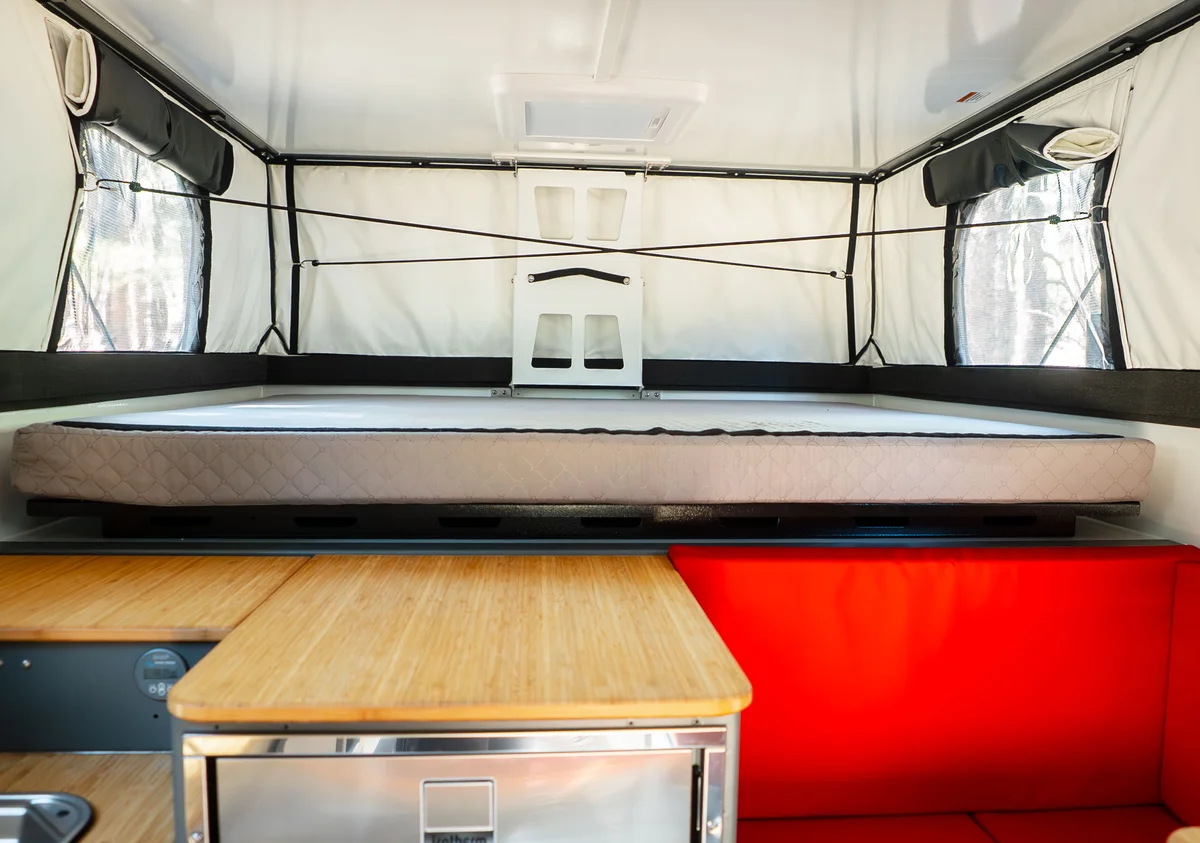
The same R&D went into the pop-up soft walls, which now use a four-layer system. For comparison, Arnold points out that a triple-pane window in your house is about R3. OEV's soft walls are very close to R4, possibly better. The composite shell itself is rated R8, which is why OEV campers are four-season, with only the water system needing winterizing.
Come Watch Us Test It
Some of these results get pushback. Other manufacturers have reached out to say OEV's tests aren't real. Each time, OEV has invited them to the facility to watch the test repeated. Nobody has taken them up on it.
Mark still wants to take a 2x4 to one of the corners in front of a live audience. If that ever happens, you'll hear about it. In the meantime, there's more on the OEV videos page, and part two of this conversation covers truck camper tie-downs and isolated mounting. For a full walk through a finished camper, see our Overland Expo Ultimate Build walkaround.
See the Full OEV Lineup
Back Country, Hudson Bay, High Country, and Summit. Same composite build, different trucks and different trips.
Built to Conquer. Built to Last.
It's easy to put a tagline on a camper. OEV earned this one with months of adhesive testing, four generations of panels, and tests run until something breaks. Browse the truck camper lineup, or talk to the OEV team and ask them anything about how it's built.