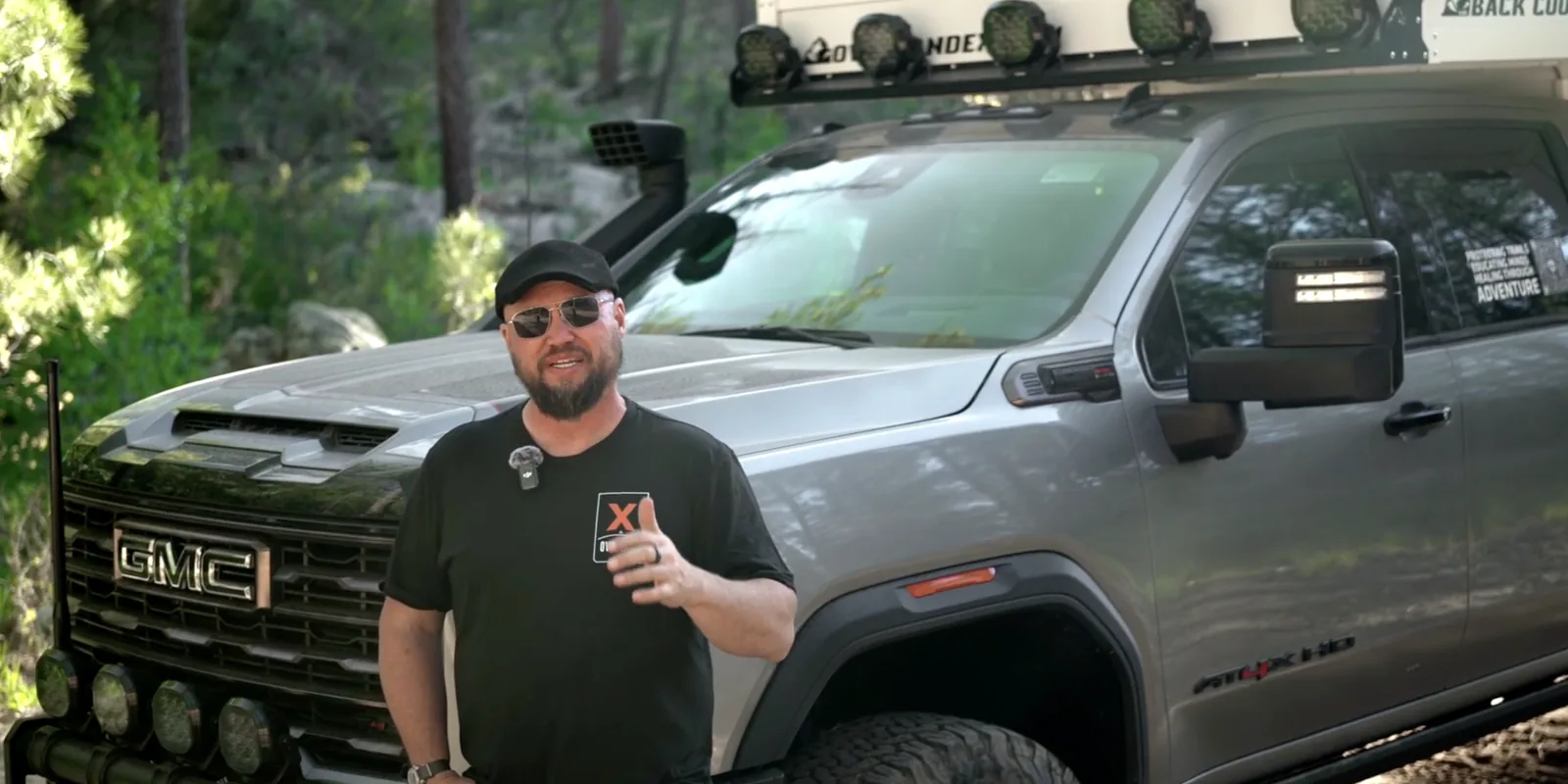
A spec sheet is written by the people selling the camper. What helps more is someone who knows overland travel opening the cabinets, pulling a panel off, and saying what he thinks, good and bad. Scott Brady did that with the Back Country 6.85.
Scott Brady is the Executive Publisher at Overland Journal, and he reviewed the 2025 Overland Expo Foundation Ultimate Overland Build for Expedition Portal in a 19-minute video published June 10, 2025. The truck is a GMC Sierra 2500 HD AT4X AEV Edition. The camper in the bed is the OEV Back Country 6.85, a pop-up slide-in truck camper that weighs 1,275 lbs dry and starts at $51,445. He called it "a four-season camper for sure," and praised the wiring, the materials, and the thought behind the details. Here's what stood out to him.
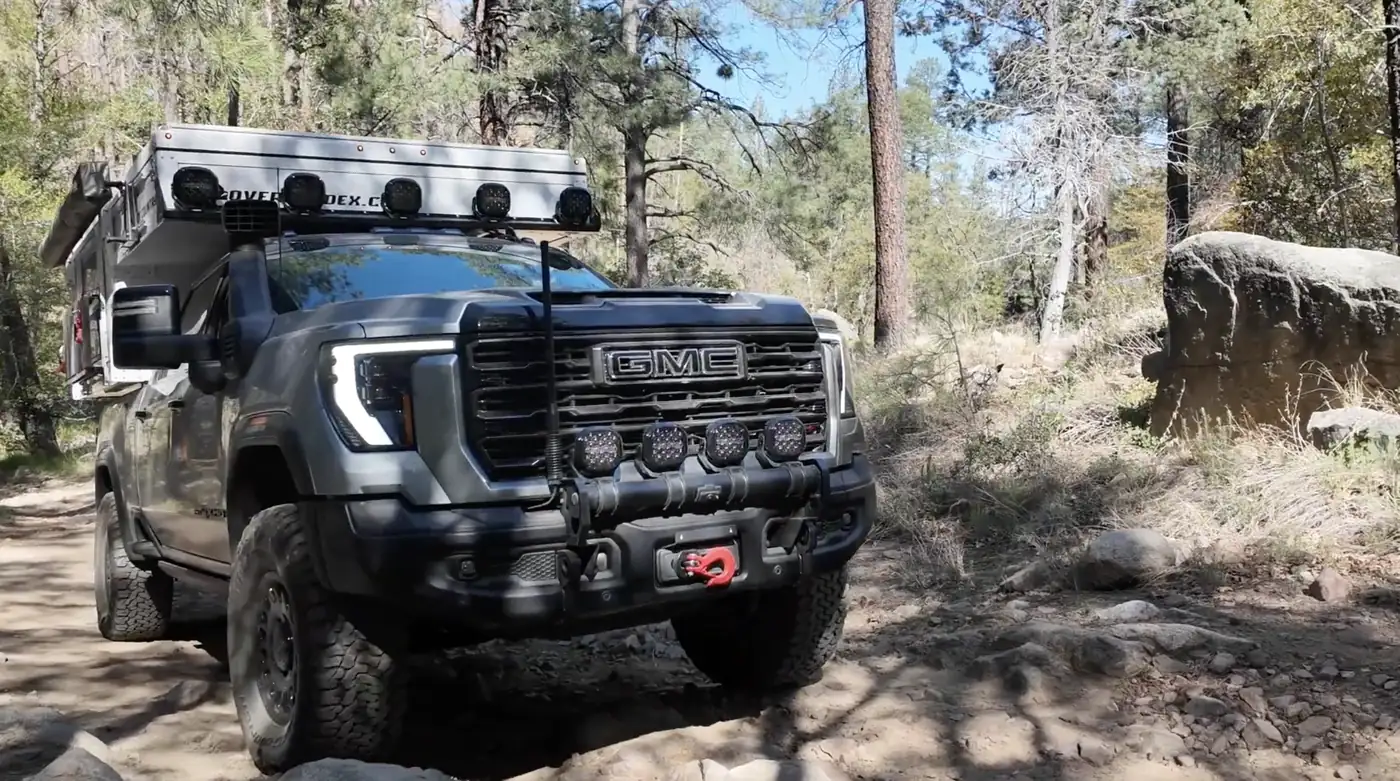
Photos are stills from Expedition Portal's video.
Watch Scott Brady's Review of the Ultimate Overland Build
Scott starts with the truck, walks the outside of the camper, then goes through the interior one cabinet at a time. Everything below follows the same order.
One thing to know before you watch. Expedition Portal publishes a No Compromise Clause with its videos: "We never have and never will accept advertorial, and we do not allow advertising to influence our product or destination reviews."
Why Scott Brady's Take Carries Weight
In the video, Scott introduces himself as part of the Overland Collective, which includes Expedition Portal, Overland Journal, XOverland, and the Overland Journal Podcast. Overland Journal's masthead describes him as "an adventurer, author, and publisher, and the first person in history to cross all seven continents."
His team also has history with OEV campers. He says Richard and Ashley Giordano have been using a very similar unit in their travels around the world. Ashley is a Senior Editor at Overland Journal. "So, we know that they're high quality," he says.
Early in the video he sums up what sets the campers apart. In his words, "what makes Overland Explorer Vehicles campers really exceptional is not only their build quality, but their four season capability."
The Ultimate Overland Build, Truck First
Scott explains the cause before the hardware. The Overland Expo Foundation supports philanthropic work in the overland community, sponsors individual travelers to attend Overland Expo events, and backs charities. When one of these builds is auctioned, the proceeds go to those charities. The 2025 rig toured all four 2025 Overland Expo events and was auctioned on Bring a Trailer, with all proceeds going to the Foundation.
Here's the truck as Scott describes it:
- Truck: GMC Sierra 2500 HD AT4X AEV Edition
- From the factory: 35-inch tires, a rear locking differential, a low-range transfer case, off-road modes, extra skid plates, and AEV bumpers front and rear
- Added by AEV for this build: the 37-inch tire kit with BFGoodrich all-terrains on the factory Salta wheels, a ComeUp winch in the front bumper, and Vision X lighting
- Payload: over 2,000 pounds available, by Scott's count
- Camper: OEV Back Country 6.85 pop-up slide-in
If you want every option on the camper explained, Arnold from OEV covers that in our walkaround of the same Ultimate Build rig.
What Scott Brady Liked About the Back Country
The shell and the hardware outside
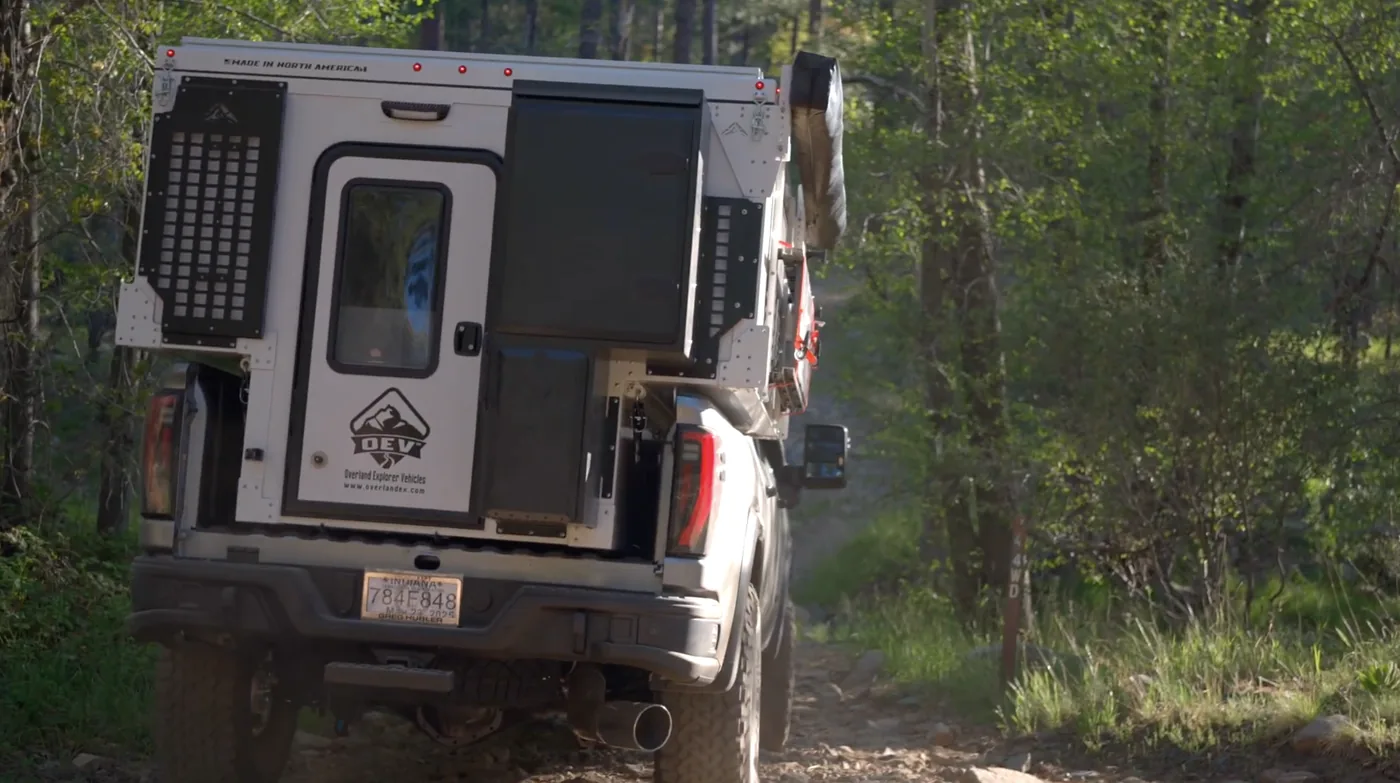
Scott starts with construction. He points to the "large flat composite sandwich panels" for insulation, then the heavy-duty aluminum corners and joints that add structure and impact resistance. His reasoning is practical. Composite panels can get dinged by branches on the trail, and strong corners help prevent that. For reference, the Back Country's composite floor, walls, and roof are rated R8, and the extrusions are powder-coated aluminum.
Around the outside he runs through the jack mounts, the locker that holds the propane tank, shore power, a second solar input, camp lighting, a lockable water fill, and the outside shower. This build paired the shower with an Alu-Cab shower cube. The brackets and adapters for an enclosure come standard, and you supply the enclosure.
He also liked the MOLLE panels for mounting recovery boards, the rear storage box, and the light bar mount across the front for long dark drives at high latitudes.
The entry door
"This door is really high quality," he says. Three details stood out to him. It locks in the open position, which a lot of camper doors don't do. The opening is tall, so you're less likely to hit your head on the way in. And the screen has a heavy-duty grating behind it, which keeps animals out and adds security while you're getting air through the camper.
The wiring
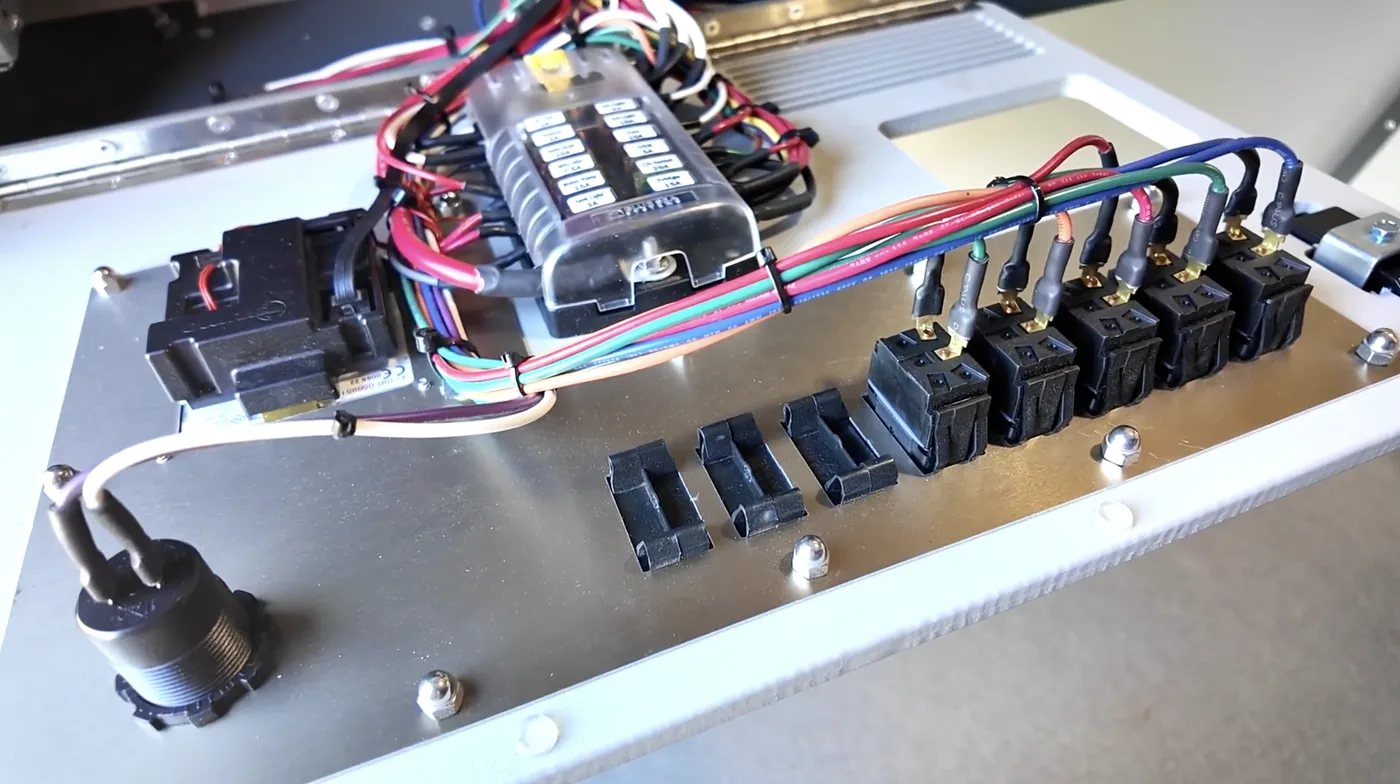
This is the part of the review most buyers never get to see for themselves. Scott opens the switch panel and looks behind it.
As he puts it, "a great indication of the quality of any camper build is to look under the surface at the wiring. And I'm seeing some really thoughtful wiring here."
What he found was color-coded wire throughout, so you know which circuit is which, plus heat shrink on the connections and room to work. He says it would be easy to get in there and diagnose a problem. On the plumbing side he points out PEX water lines with shut-off valves, so a problem in one system can be isolated from the rest.
The galley
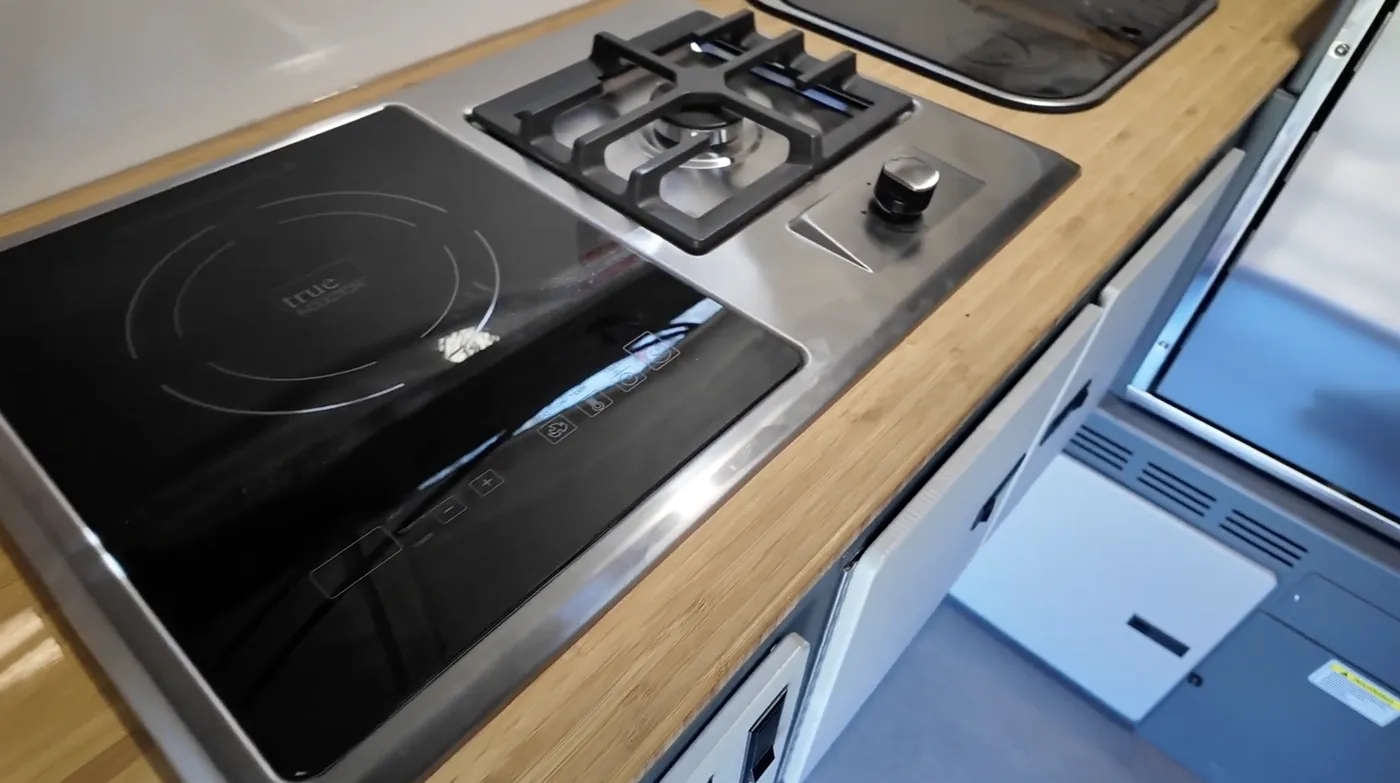
The Ultimate Build has the optional induction and propane cooktop, one burner of each. It replaces the standard two-burner propane cooktop and needs the 2000W inverter. Scott didn't expect to like the combination, then came around on it for the redundancy, saying he was "starting to appreciate the idea."
He liked the deep sink and its cover, which gives the counter space back when you aren't washing dishes. He also called out the upper counter. "This counter space up here is actually fairly unique to this OEV camper because you end up with a lot more counter space," he says.
The Xantrex display read 57.9 percent battery when he checked it, and he notes it would climb quickly because he'd just started the truck. The Back Country comes standard with a Victron Orion XS DC/DC charger, which charges the house battery from the truck.
On the optional fridge, he's balanced. A front-opening fridge spills cold air when you open it, so it's less efficient than some other layouts. It's also very easy to use, and with the battery capacity on this build he doesn't see it as a problem. There's a small freezer too.
One more detail he called clever is the fresh water tank. Flip a switch and a light shows you the water level.
The bed and the soft walls
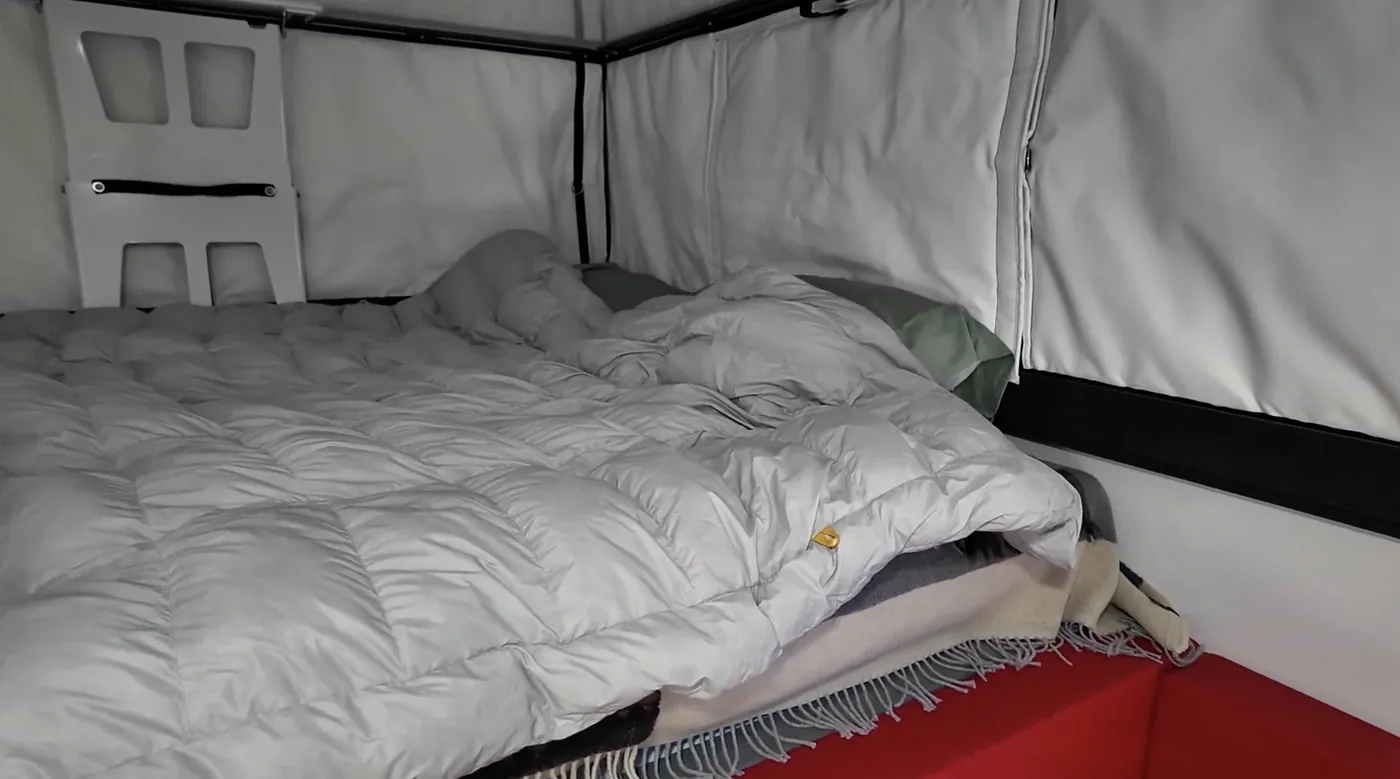
The queen bed runs east-west. Scott says that layout works well in a full-size camper, and adds that "even me at 6'1, I can stretch out completely across the bed" with room to spare. If you're taller than that, the king bed extension is on the options list.
Then he gets to the fabric walls. The Back Country's soft walls are four layers, fire-rated, insulated, and rated R4. Scott makes the point that the insulation comes with the camper. "It's not an accessory. It just comes ready for really cold conditions," he says. "So even though it's a pop top, this is a four-season camper for sure."
He also noticed the foam strips along the aluminum at the top of the walls. They break the thermal path between outside and inside, so condensation doesn't build up on the metal and drip. That thermal break foam kit is standard. As he put it, "Clearly, they're designed, engineered, used in Canada in really cold conditions." Every OEV is built in Red Deer, Alberta.
Scott spends a lot of the review on cold weather, so one clarification matters. The Back Country is a four-season camper you can use year-round. The water system is the three-season part, and it needs to be winterized before freezing temperatures.
The roof, the fans, and the window
The roof lifts on four heavy-duty struts. Scott notes it's a heavy roof for good reasons: it carries the 220W solar panel and the fans, and it's built to hold up under snow load.
This build has two roof fans, which lets you push air in with one and pull it out with the other. One fan is standard and the second is an option. Scott's view is that in most cases this much airflow will take the place of an air conditioner.
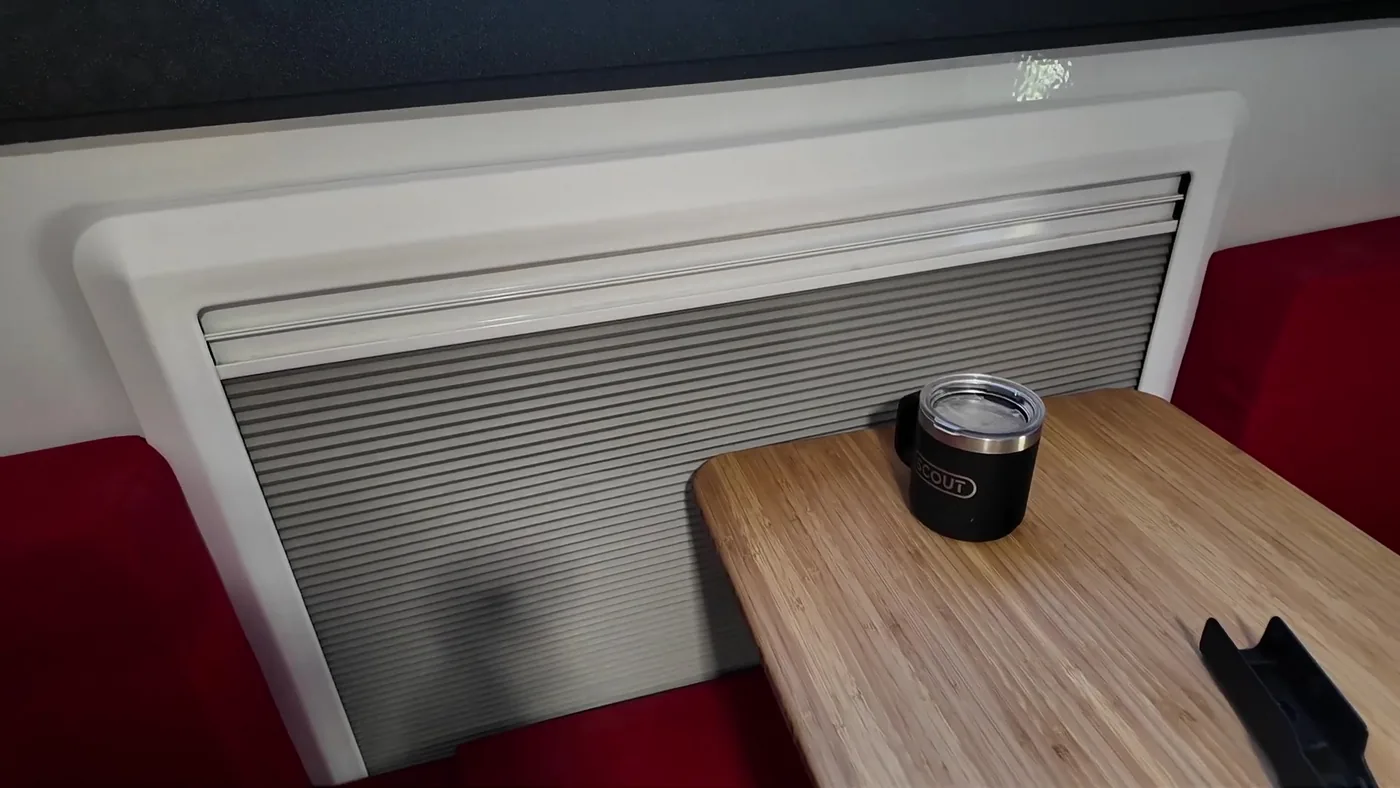
The side window got a specific compliment. The privacy blind pulls up from the bottom and the bug screen pulls down from the top, so you can leave a gap at the top for air and still have privacy. "The privacy screen should always come up and the bug screen should always come down," he says, and he's surprised how many camper manufacturers get it backwards.
Sleeping with the roof down
Scott thinks every pop-up should give you a way to sleep with the roof closed. Weather can get too rough to raise it, and a lift system or the fabric can get damaged far from home. Sometimes you'd simply prefer not to advertise that you're camping, like an overnight at a gas station or in a city.
The Back Country's dinette converts to a 38 by 77 inch bed. "This is a key feature, being able to sleep in the dinette, and it does that quite well," he says. Later he closes the roof to show there's plenty of room to sleep inside, and enough to sit up on the ledge.
The overall verdict
"So overall, I'm just seeing really premium use of materials and very thoughtful features," Scott says. "Of course, that's reflected in the MSRP, but even the MSRP is reasonable."
Which Truck It Fits
The Ultimate Build put the Back Country on a three-quarter-ton GMC Sierra 2500 HD. Scott says a truck like this "is going to easily carry a truck camper." He also explains why the 6.85-foot length matters. It fits the shorter beds on four-door HD trucks, and it's still a full-width camper, so the interior feels spacious once the roof is up.
The Back Country fits factory half-ton, three-quarter-ton, and one-ton trucks with 6'0" to 6'8" beds, and it weighs 1,275 lbs dry, excluding jacks and batteries. On a half-ton, check the payload on your driver's door sticker and plan for water, batteries, and gear on top of the dry weight. Any of the OEV dealers can help you match a truck to the camper, and the slide-in pop-up truck camper guide covers the trade-offs.
Even on a three-quarter-ton, it's easy to overload exterior lockers. Scott's rule is to keep the light stuff in the rear box, like chairs, camp equipment, and maybe some firewood. Recovery gear and tools go inside the truck, as far forward as you can get them.
Back Country or Hudson Bay?
The bathroom is the clearest way to tell these two apart. The Back Country keeps your factory bed, fits half-ton through one-ton trucks, and handles showers outside. The Hudson Bay 6.75' pop-up needs a flatbed and a three-quarter-ton or one-ton truck, and in return it adds a wet or dry bath and a longer interior. Same composite build, different trucks and different trips.
He also mentions that OEV builds fully hard-sided campers. The Hudson Bay 8' flatbed hard side is one of them.
Price and Build
The Back Country 6.85 starts at $51,445. That covers the standard build, including the composite shell, the insulated soft walls, Truma heat and hot water, 220W solar with Victron charging, the 20-gallon water system, the queen bed, and the C-shaped dinette.
Several things Scott shows in the video are options you'd add on top: the induction and propane cooktop, the 2000W inverter, the fridge, the second roof fan, the light bar, the MOLLE panels, and the rear storage box. You can price each one in the configurator.
Configure Your Back Country
Start with the standard build, add the options from the Ultimate Build that fit how you travel, and watch the price update as you go.
Built to Conquer. Built to Last.
Scott Brady closes the video by saying the build "is certainly ultimate and it goes to a great cause." He opened panels, checked the wiring, and tried the dinette with the roof down. The camper he reviewed is the same Back Country you can order today. Build yours in the configurator, or talk to the OEV team about what fits your truck.