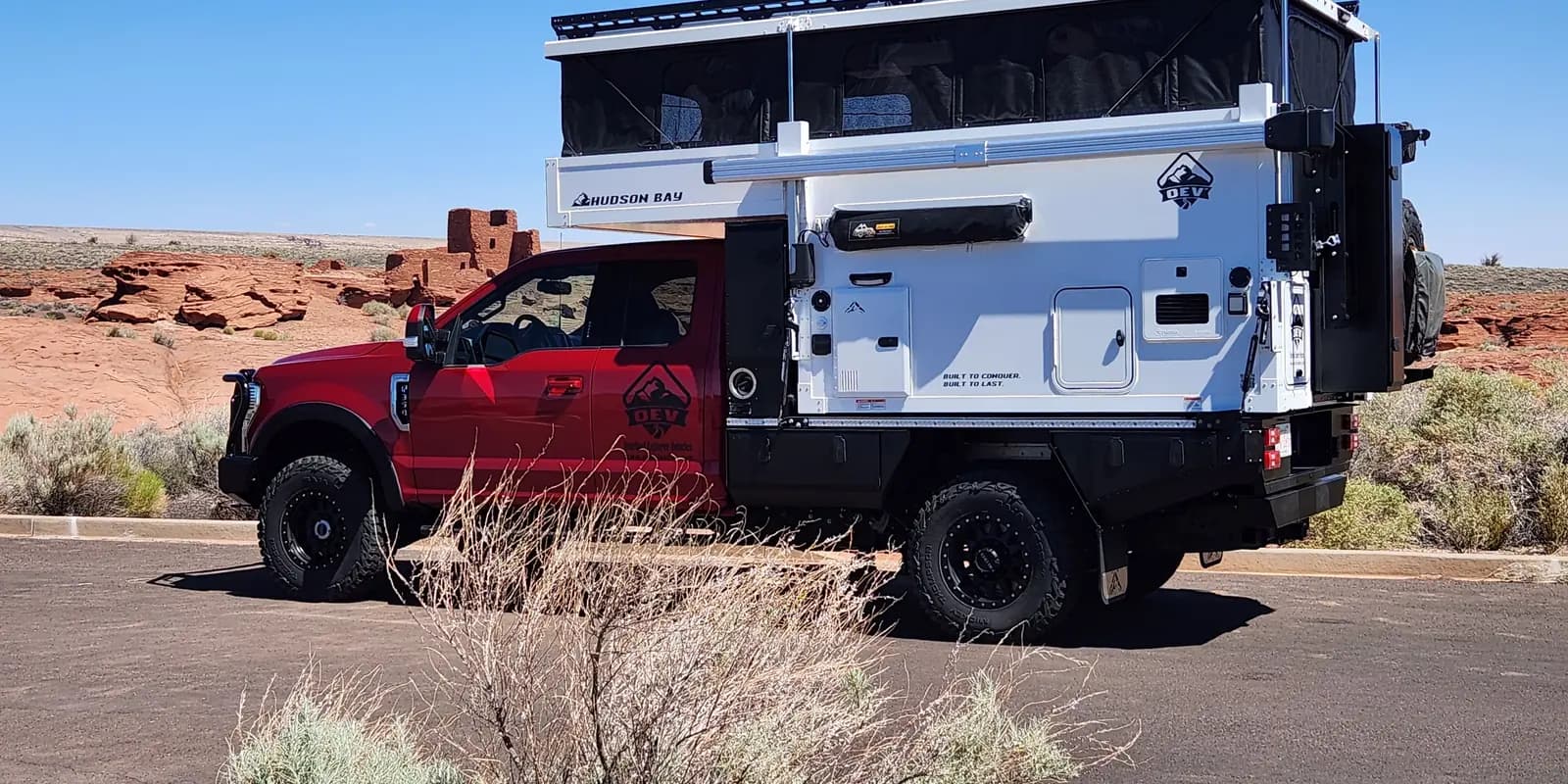
Most talk about truck camper strength stops at the walls. But a strong camper bolted rigidly to a flexing truck will still crack somewhere eventually. The tie-downs and mounts decide whether all that strength lasts, and OEV's answer is to isolate everything.
Overland Explorer Vehicles (OEV) isolates its truck campers at every layer. Integrated chassis units sit on a subframe that's isolated from the truck's chassis. Flatbed and slide-in campers ride on rubber feet and are held down with Torklift Derringer tie-downs that let the camper shift slightly and then pull it back to center. Inside, the aluminum extrusions and furniture are bonded to the composite panels, so the whole cabin can flex with the truck. This is part two of Ken's sit-down with Arnold from OEV at Overland Expo Mountain West. Part one covered how the campers are built and tested. This one covers how they're mounted, across the full truck camper lineup.
Why a Rigid Mount Eventually Fails
Talk to Arnold or Mark at a show and they'll usually start from the bottom up. The first idea is simple. The truck and the camper need to move independently of each other.
Bolt a camper rigidly to a truck and every twist of the frame goes straight into a handful of mounting points. That's point loading. Metal doesn't like to be cycled, and aluminum in particular fatigues when it flexes over and over. Put enough trail miles on a rigid mount and, in Arnold's words, "you're going to have failure eventually."
Arnold's advice holds no matter who builds your flatbed, whether it's Aluma Tray (OEV's sister company under Lite Industries) or another manufacturer. Ask whether the flatbed can be isolated from the truck's chassis. If it can't, as Arnold puts it, "you're just going to have problems."
Chassis-Mounted Campers Sit on an Isolated Subframe
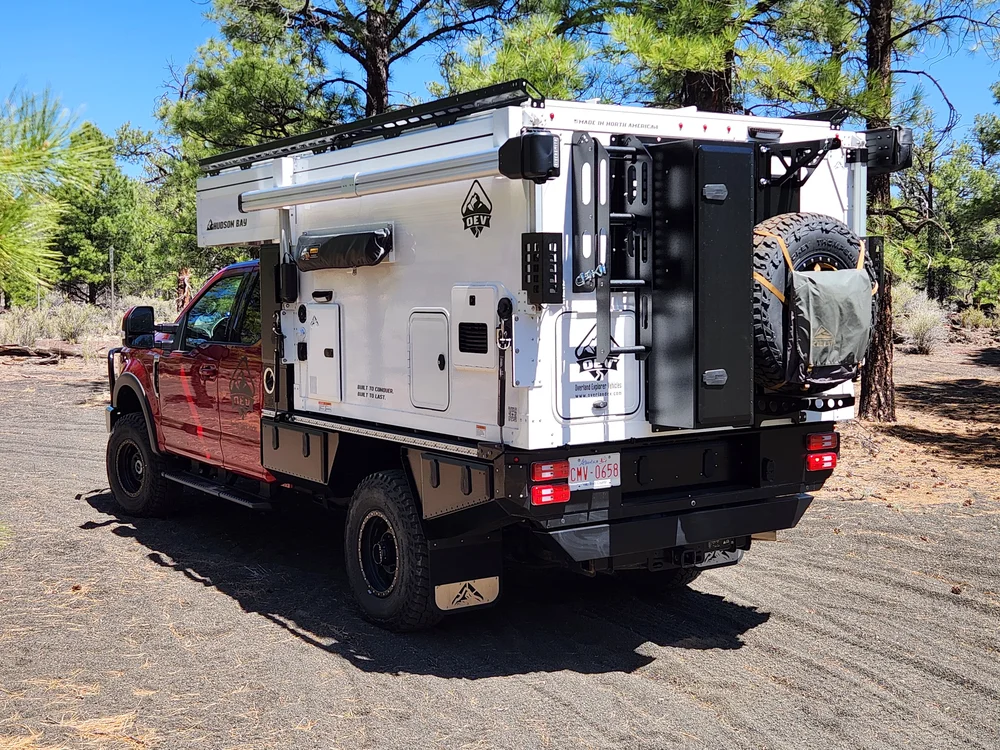
The camper behind Arnold during the interview was an integrated chassis unit, and it shows the idea clearly. The cabin connects to a subframe. The subframe connects to the truck's chassis. The cabin never bolts straight to the frame, so it's fully isolated from it.
OEV builds chassis-mounted versions of the Hudson Bay 8', the High Country, and the Summit. On the Summit's spec sheet, you'll see it listed as a multi-point isolated kinetic cabin mounting system.
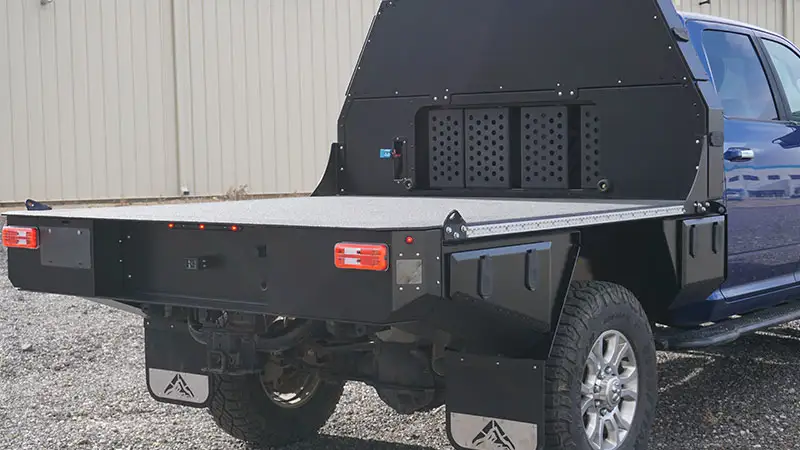
Flatbed Campers Are Isolated From the Tray
The same thinking carries over to flatbeds. When an OEV camper goes on a flatbed, the camper is isolated from the flatbed too.
Torklift Derringer latches hold it down. The rear latches are spring-loaded, and the front latches use a rubber torsion design. Both are there to let the camper move a little instead of fighting the truck. Underneath, the camper sits on rubber feet rather than resting metal on metal against the deck.
If you're running an Aluma Tray flatbed, the tray has Torklift Derringer anchor points at all four corners. For the bigger picture on going flatbed, the flatbed information page covers the basics.
Slide-In Campers Ride on Rubber Feet Too
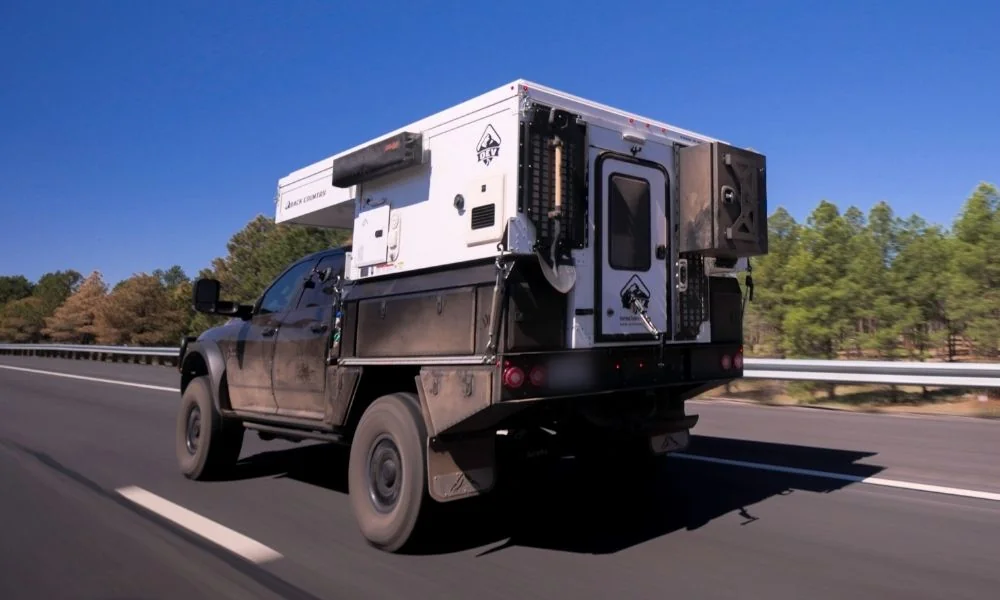
This isn't only a flatbed thing. Arnold points out that any OEV camper on a flatbed or in the back of a pickup has rubber feet mounted underneath it.
On the Back Country 6.85, OEV's slide-in, a Derringer tie-down kit with two front and two rear tie-downs is on the options list. For how the Back Country's front bar mounts directly to the truck frame, see the Ultimate Build walkaround.
The Cabin Is Bonded So It Can Flex
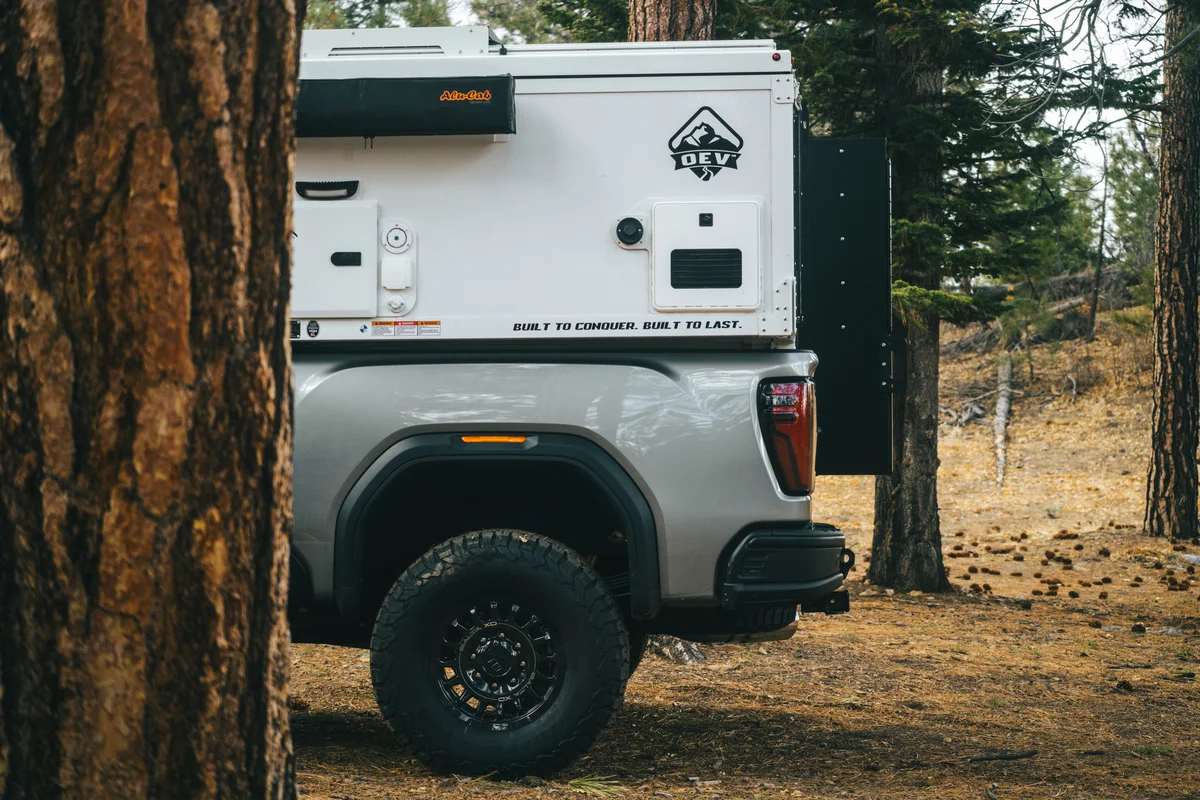
Isolation doesn't stop at the mounts. Inside the camper, the aluminum extrusions are bonded to the composite wall panels, and the furniture is bonded into place rather than screwed down.
The reason is the same. Off-road, the camper takes every kind of vibration and flex at once. Arnold calls it the whole gamut. A bonded structure can move with all of that and return to center, so there's no rigid joint sitting there waiting to fail. Part one covers the adhesive testing behind those bonds.
"It's pretty simple really," Arnold says, "but you got to apply it all the way through." You can't isolate one area and hope for the best on the rest. OEV applies the same thinking to the entire build, from the chassis up to the cabinets.
"Is That Really Going to Hold It?"
People ask this at every show when they see the tie-downs. Arnold's honest answer is that on the trail, the camper might slide over a little. Then the spring and rubber in the latches pull it back to center.
Ken has followed one of these campers up a trail so steep the windshield showed nothing but sky. The camper didn't budge. It stayed right where it belonged.
Arnold sums up the whole approach in one line: "If you eliminate the points where you could have failure, then you're going to have great success."
Slide-In, Flatbed, or Chassis-Mount?
Every OEV mounting style follows the same rule, so the choice comes down to your truck and how you like to travel.
- Slide-in: The Back Country fits a factory bed on half-ton, three-quarter-ton, and one-ton trucks with 6'0" to 6'8" beds. The slide-in pop-up truck camper guide covers the trade-offs.
- Flatbed: Hudson Bay flatbed campers and the High Country pop-up ride on a flatbed and come off when you want the truck back. See the flatbed truck campers overview.
- Chassis-mount: The Hudson Bay 8', High Country, and Summit chassis-mount cabins stay on the truck full time.
Slide-In, Flatbed, or Chassis-Mount
Every OEV camper is isolated from the truck. Compare the models and find the one that fits your rig.
Built to Conquer. Built to Last.
A camper is only as tough as the way it's attached. OEV isolates the cabin from the chassis, the camper from the flatbed, and every panel and cabinet from the next, so the whole rig can flex without anything fighting itself. Got a question you'd like answered on video? Leave a comment on the OEV YouTube channel, browse the truck camper lineup, or talk to the OEV team.